Hurty/Craig-Bampton models with interface reduction for mechanical joints
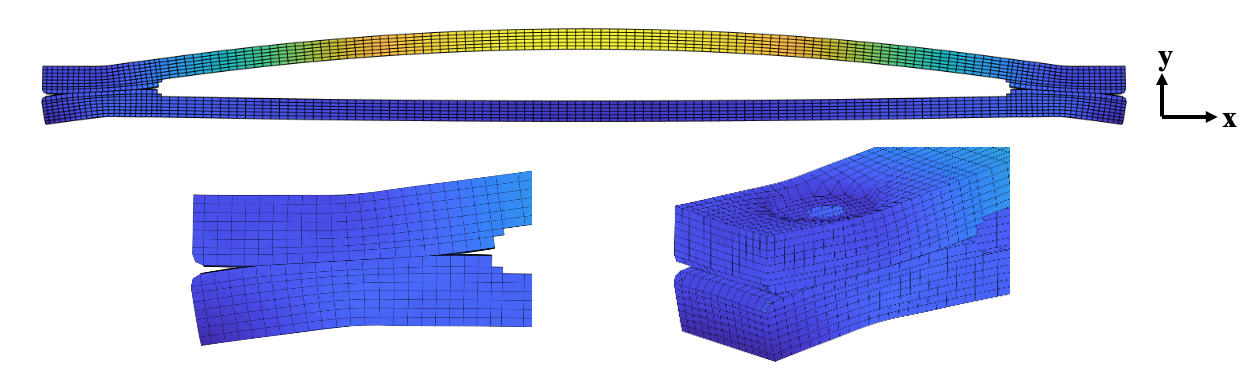
Figure 1: A close-up view of interface deformation along the contact surface of two C-Beams after static preload.
The present work explores the perfomance of interface reduction techniques (i.e. Hurty/Craig-Bamption substructuring and system-level characteristic constraint modes) on a
nonlinear model with node-to-node contact for a benchmark structure consisting of two c-shape beams bolted together at each end. The use of Hurty/Craig-Bamption substructuring and
system-level characteristic constraint modes greatly reduces the computation time for jointed structures analysis compared to full model analysis.
Background & motivation:
Finite element analysis is a popular computational analysis method in nowaday research across many disciplines. However, in order to accurately capture the physics at play, finite element models usually require
extremely fine mesh with potentially hundreds of thousands of elements and millions of DOF. This is rather computational costly and time intensive.
In models with substructures connected to one another via contacting boundary conditions, the interface DOF may control the dynamic response of the system, while the numerous interior
(non-interface) DOF provide unnecessary model redundancy. One way to minimize computational reduncancy is by reducing interior DOF through CMS methods, which approximate the substructure interior with a relatively
small set of mode shapes, while leaving the interface DOF unchanged. One such method is the Hurty/Craig-Bampton technique.
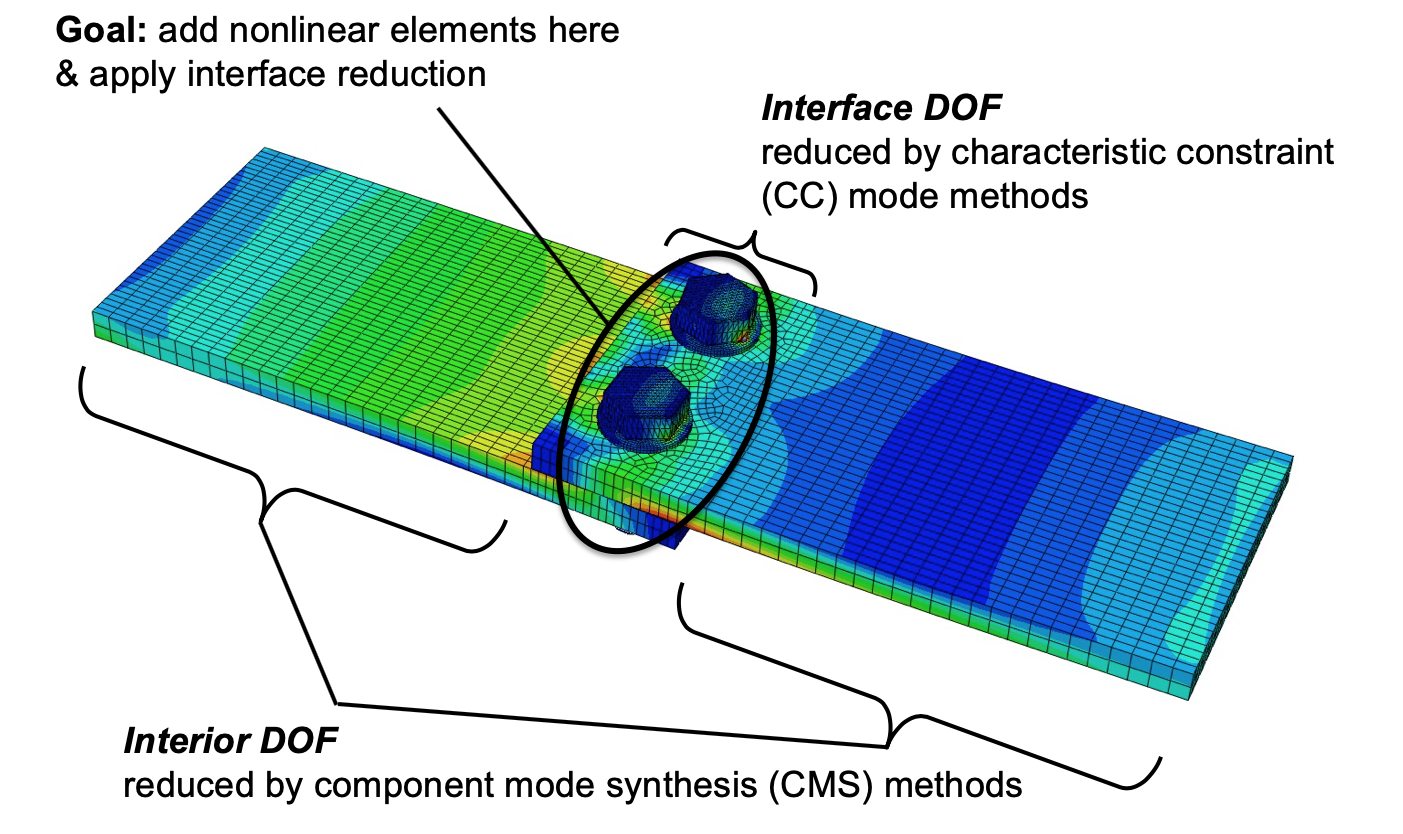
In order to achieve optimal speedup, interface reduction technique can be used to further alleviate computational burden. Any interface reduction basis must satisfy a number of criteria: (1) allow for realistic deformations in the contact area, (2) reproduce the distribution of contact forces, (3) match the overall dynamic response of the HCB model within a reasonable margin of error, and (4) be efficient enough to provide overall computational savings. In the present work, an interface reduction tenchique, Extended System-Level Characteristic Constraint Modes, is utilized to reduce the DOF along the contact interface.
If you are interested in learning more, feel free to check out the following article for more details of the reduction methods as well as some of the research findings:
Patrick Hughes, Wesley Scott, Wensi Wu, Robert J. Kuether, Matthew S. Allen, and Paolo Tiso. 2018. "Interface Reduction on Hurty/Craig-Bampton Substructures with Frictionless Contact", In: Kerschen G. (eds) Nonlinear Dynamics, Volume 1. Conference Proceedings of the Society for Experimental Mechanics Series. Springer, Cham.
Figure 2: A substructure model.
In order to achieve optimal speedup, interface reduction technique can be used to further alleviate computational burden. Any interface reduction basis must satisfy a number of criteria: (1) allow for realistic deformations in the contact area, (2) reproduce the distribution of contact forces, (3) match the overall dynamic response of the HCB model within a reasonable margin of error, and (4) be efficient enough to provide overall computational savings. In the present work, an interface reduction tenchique, Extended System-Level Characteristic Constraint Modes, is utilized to reduce the DOF along the contact interface.
If you are interested in learning more, feel free to check out the following article for more details of the reduction methods as well as some of the research findings:
Patrick Hughes, Wesley Scott, Wensi Wu, Robert J. Kuether, Matthew S. Allen, and Paolo Tiso. 2018. "Interface Reduction on Hurty/Craig-Bampton Substructures with Frictionless Contact", In: Kerschen G. (eds) Nonlinear Dynamics, Volume 1. Conference Proceedings of the Society for Experimental Mechanics Series. Springer, Cham.